With great interest I am watching the creation of OpenRxiv (https://openrxivlabs.org/about), an experimental project for BioRxiv and MedRxiv.
My humble wish is that they move quickly to destroy the for-profit publishing industry.
In today’s funding climate, biologists and stakeholders should NOT accept so much publicly funded science and money being held by private middlemen. It is an issue that Elsevier makes over $2 billion in profits each year. This is a massive, unnecessary inefficiency, much like choosing driving a Hummer instead of a normal car or bike. Software and centralization are the solution, and BioRxiv and MedRxiv can act unilaterally to do it.
BioRxiv and MedRxiv can automate the industry’s useful functions and it will save everyone time and money. The most useful functions for-profit journals provide, in my opinion, are peer review, a heuristic of paper quality, and grouping papers by theme. Peer review is the biggest issue. BioRxiv and MedRxiv explicitly say that they do not do peer review, but that is the crucial function they must do.
Automating these functions won’t be perfect, but it’ll be far better than the status quo of paying, waiting, and extra labor.
Finding reviewers
Sadly, now, authors rely on editors at for-profit journals to find reviewers or have them suggested, upon which the paper enters peer review for weeks – or years!
Instead, OpenRxiv could have algorithms use coauthor and citation networks to suggest the most appropriate reviewers. (The system for finding everyone and verifying everyone could be ORCID.) Often, but not necessarily, these will be people who work on very similar subjects. A “ladder ranking system” can be used, where peers are mostly ranked by their peers. Researchers highly cited by others (not themselves) will typically review other highly cited researchers. Once automatically selected, reviewers are automatically notified and must agree within 7 days. However, everything above happens after submitting and posting the preprint, so there is no delay for peer review unless requested by the author.
The algorithm for selecting reviewers should try to balance the load across reviewers. It would be a good idea to publicly indicate who (by name) declined to review, delegated a review (e.g. to a trainee), and who did not reply. It might seem icky, but it’s just transparency, and I think we’ll all get used to it.
Heuristic of paper quality
Sadly, now, readers use journals as a heuristic of how impressive the paper is, including for hiring and performance evaluations. Many a PhD and postdoctoral researcher have sacrificed years of their lives to the “CNS” altar.
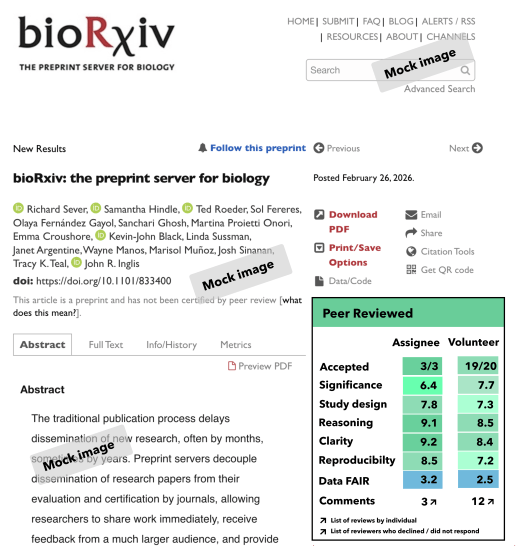
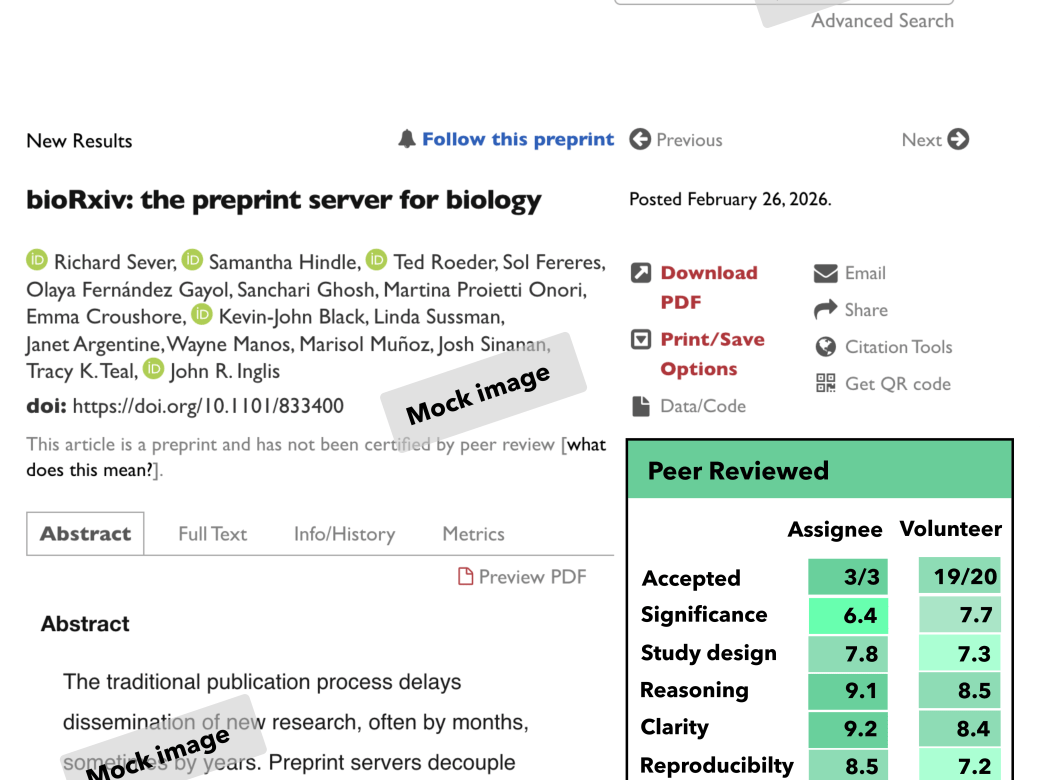
Instead, the peer review process could result in a score to indicate quality and in a vote (pass/fail) to indicate any invalidating errors. There is no decision to publish or not publish by an editor or anyone else because the preprint has already been shared. The submitter can accept a low score or try to improve the paper and request another round of peer review. This system addresses one of the lamest parts of peer reviewed papers, which is reviewers and editors judging whether a paper is worthy for a particular journal.
Beyond assigned reviewers, anyone can volunteer to provide a review on a second track. This two-track system would work like Rotten Tomatoes, where a movie has a critic score and an audience score. (While a “comments” section is helpful, scoring on an explicit rubric is needed for a rubric). This backstop could be especially helpful for catching lines that reviewers overlooked. Voluntary reviewers could indicate uncited prior work that should have been cited or call out unearned claims about impact or relevance.
A nice benefit is that industry scientists like me can more formally participate in reviewing publications.
Grouping papers
If we do all of the above – won’t readers still want to use journals to find new content of a particular type, like the Journal of Bacteriology?
Instead, authors can self-select detailed categories (e.g. microbiology > genomics > etc.) and keywords or have them assigned by an automated text classifier. Readers can filter papers to those of particular categories and labels, including those with higher or trending citations. The inventory of the preprint server can be organized
Beyond journal-like groupings, there are many ways to help scientists to find relevant new publications. One example is an email digest of “recommended articles” or authors you subscribe to, like Google Scholar. Another example is grouping of seminal papers, as done here: kuod.github.io/compbio-field-guide/.
A better publishing world is possible
This wouldn’t just fix the for-profit issue, it would improve how science is done:
- Faster. This system makes peer review faster, and it takes control out of an editor’s hands (pass/fail) and into a scientist’s hands (decide to improve or let issues linger).
- Fairer. Papers will not be judged based on an arbitrary decision of getting into a CNS journal or not. Centralization in one organization is more efficient for social interactions. Reviewers (assigned or voluntary) can be rewarded for the number and quality of their reviews in a way that cannot be done with individual journals. Hiring and promotion committees can now assess candidates on how well they help others do science via peer review.
- Incentivizes trustworthy science. Too many papers are not good, and predatory journals are only partly to blame. Scientists should be producing reproducible, quality results, not padding or overhyping papers or squeaking things by reviewers whose feedback is usually private. Peer review resulting in quantitative scores, instead of a binary in-or-out, means higher quality science is incentivized.
Preprints are already fast ways to share science, but not everyone does them or cites them. What’s in it for those researchers? Adding a peer review system rewards prosocial behavior and so creates a virtuous cycle: people benefit from participating (faster, fairer, truthier), so more people participate, so more people benefit.
A sign that this system is working well? Paying to publish will become seen as gaudy, wasteful, and antisocial as driving a Hummer.