What if universities used undergraduates to make biological reagents? Training people in biomanufacturing, and using their outputs, could reduce research costs with plenty of other benefits.
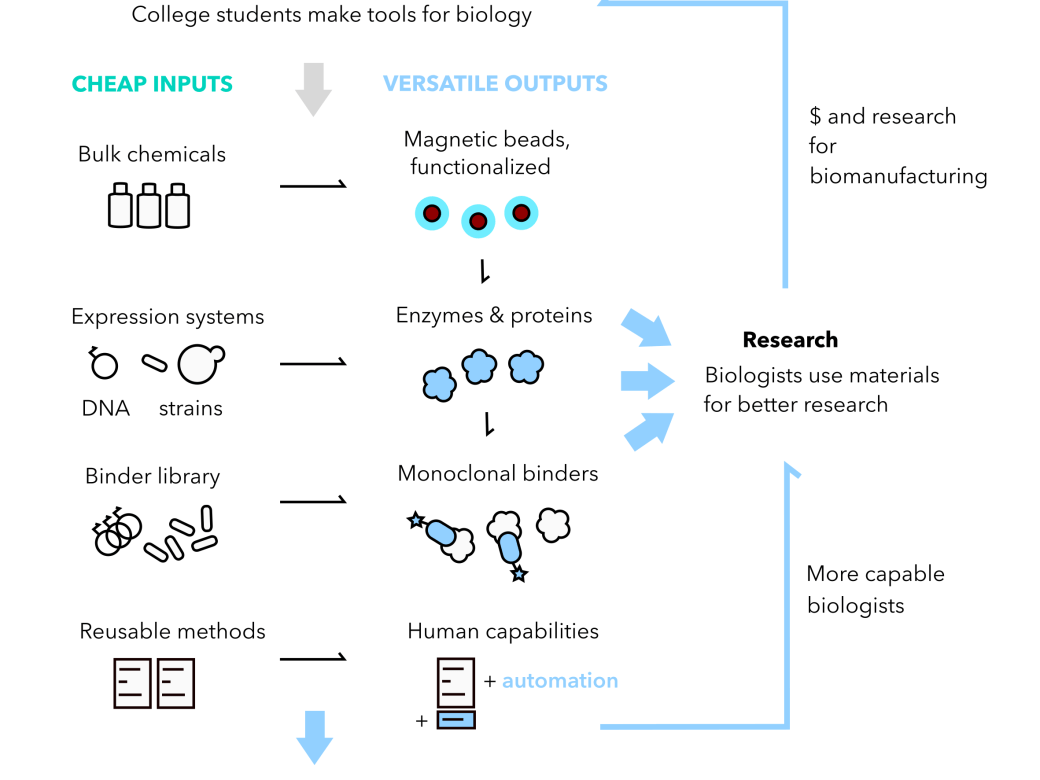
Here’s a diagram of how I think this would work:
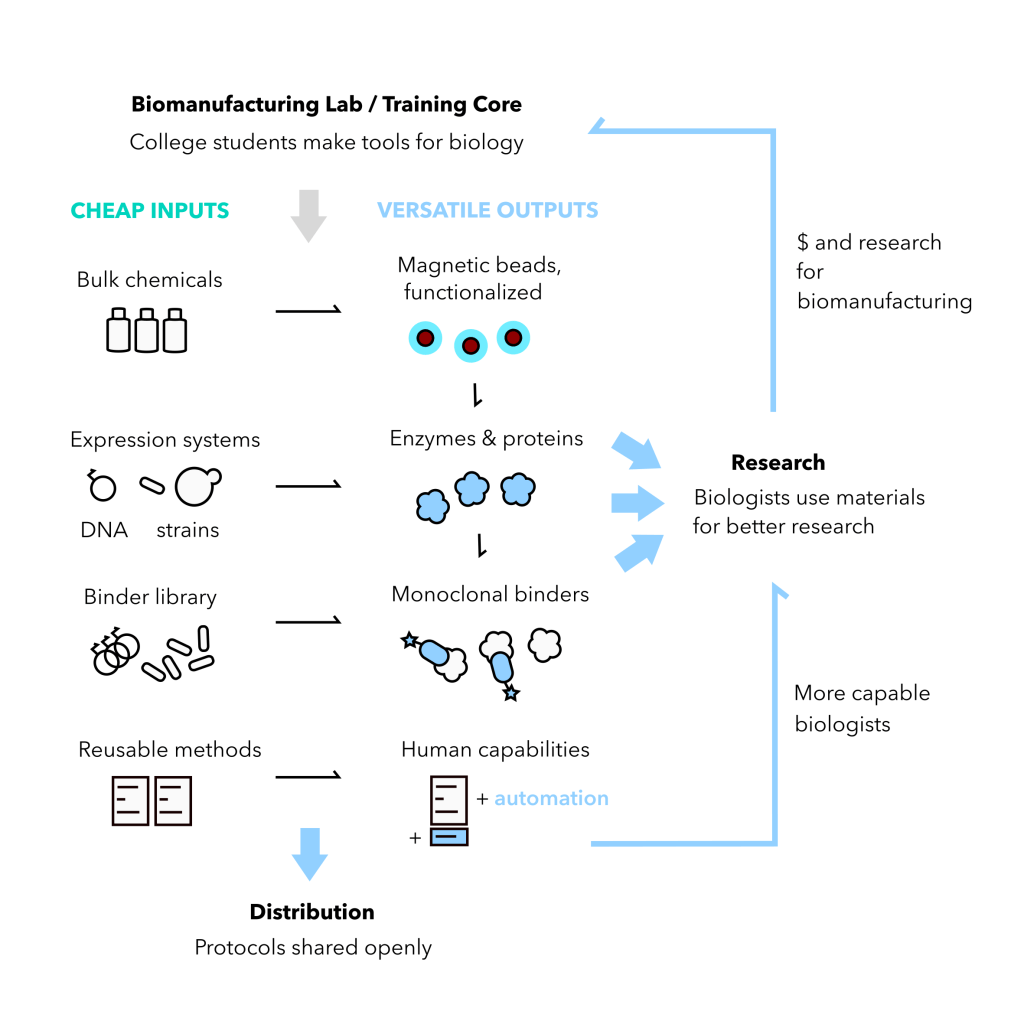
The problems a college biomanufacturing core touches are: (1) giving more students opportunities for meaningful hands-on experience, (2) training a workforce for the bioeconomy, (3) biology is expensive, (4) insane cuts to science funding by the U.S. government
It can be economical & bootstrappable, I think, to focus on: reusable paramagnetic beads for purification, proteins synthesized by microbes, and synthetic monoclonal antibodies. The outputs are versatile, yet the process is standardized, the inputs are cheap. You make most of what you need.
A lot of academic labs already make their own enzymes, but the cost-benefit doesn’t always make sense for 1 lab. That’s why New England Biolabs exists. Formalizing a program to service all labs adds benefits: more students trained, more reagents made, more network effects as labs cooperate.
For the perspective of an individual lab, these services may not save much money, but more money stays in the university for training and education instead of being paid out to third party companies and their investors.
And there are other important benefits: (A) These students will take their know-how with them to make an impact in new labs and companies. A lot of good research hasn’t happened because people didn’t have that kind of agency. (B) These cores may inspire new research – like new molecular tools, automation methods, and ways to have a global impact by sharing affordable production methods. (C) Colleges can specialize for the purposes of branding e.g. add a module for plant genome editing or industrial fermentation. They may even consider programs, similar to agricutlural extensions, that help small biotech operations get off the ground.
How to start?
- If you run a lab course, change the last section to be making an enzyme to give to your department, then add.
- If you’re hiring students for summer research, have their project be setting up this service for your university.
Someone could have an outsized impact across universities by establishing the key protocols that together are economical, creating collaborators, and making an open system for sharing protocols and materials. What’s the essential seed for another college to start?
Appendix:
- Magbeads: here’s how to make beads onto which proteins and other molecules can be attached, which you can use for magnetic purification: https://pmc.ncbi.nlm.nih.gov/articles/PMC6343928/
- Monoclonal antibodies: here’s why synthetic mAbs are helpful for making biology more reproducible (https://www.antibodysociety.org/learningcenter/antibody-validation-webinar-series/) and an open-source library (https://doi.org/10.7554/eLife.105887.3)
- Automation: here’s how to make a simple liquid handling robot: https://pmc.ncbi.nlm.nih.gov/articles/PMC9645590
- Proteins: here’s how to make proteins from plasmids (https://pmc.ncbi.nlm.nih.gov/articles/PMC10643540/) and some enzymes to make (https://www.addgene.org/depositor-collections/open-enzyme/)
- Other inspiration: enzymes in dried lysates (https://pubmed.ncbi.nlm.nih.gov/34061896/), environmental sensors (https://pubmed.ncbi.nlm.nih.gov/41671650/)
 Tyler Barnum